

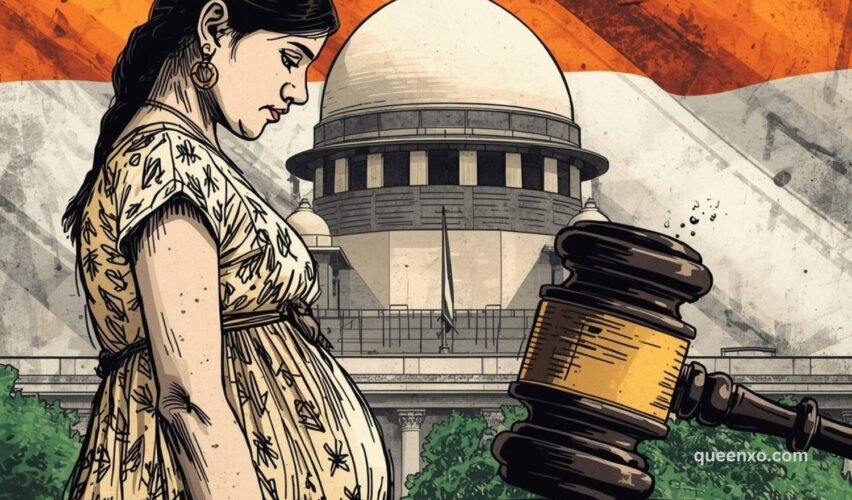
In a landmark judgment on February 6, 2026, the Supreme Court of India permitted the medical termination of a 30-week pregnancy for a minor girl, setting aside a Bombay High Court order that had directed her to carry the pregnancy to term . The ruling, delivered by a bench comprising Justices B.V. Nagarathna and Ujjal Bhuyan, has reignited a deeply polarizing debate: when a minor’s physical and mental well-being collides with the viability of a late-term fetus, whose rights should prevail?
The case involved a 17-year-old girl whose pregnancy resulted from a relationship with a friend. Her mother alleged coercion and filed an FIR, though the court clarified that its decision did not turn on whether the relationship was consensual or constituted sexual assault . The Bombay High Court had previously denied permission, noting that the fetus was healthy and viable at 30 weeks, directing instead that the girl receive medical and psychological support until delivery and that the child be placed in an orphanage . The Supreme Court overturned this, holding that “the court cannot compel any woman, much less a minor child, to complete her pregnancy if she is otherwise not intending to do so” .
The Legal Framework: Statutory Limits and Constitutional Override
Under the Medical Termination of Pregnancy (MTP) Act, 1971 (amended in 2021), termination is permitted up to 20 weeks based on a single doctor’s opinion, and up to 24 weeks for specific categories including rape survivors and minors, requiring the opinion of two doctors . Beyond 24 weeks, termination requires judicial permission, with courts typically invoking their extraordinary powers under Article 142 of the Constitution to grant relief in exceptional circumstances .
The Supreme Court’s February ruling represents what legal analysts describe as “a profound shift from a clinical, gestational age-based approach to one rooted in constitutional values of maternal dignity and autonomy” . The court explicitly anchored its decision in Article 21 of the Constitution, which guarantees the right to life and liberty, interpreting reproductive autonomy as an essential component of this fundamental right .
The Conflict: Two Competing Constitutional Interests
The case placed the judiciary in what it acknowledged was a “difficult” position . On one hand, the state has an interest in protecting potential life, particularly where a fetus at 30 weeks is viable—capable of surviving outside the womb with fully formed hands, opening and closing eyes, and responding to external stimuli . On the other hand, the minor’s reproductive autonomy, her mental health, and the social consequences of carrying an unwanted pregnancy to term weighed heavily.
Justice Nagarathna captured the tension during the hearing: “It is also difficult for us to decide what to do. Whether we should compel her to give birth to a child? Because the child which will be born is also ultimately going to be a life. Then there is another question: if she can terminate at 24 weeks, why not at 30 weeks? Ultimately, she doesn’t want to continue the pregnancy. Bottom line is she doesn’t want to give birth, that is the difficulty” .
The court ultimately tilted the scale in favor of the minor’s reproductive autonomy, emphasizing that her “clear and consistent unwillingness to continue the pregnancy” was the decisive factor . It noted that compelling her to continue would risk driving vulnerable women toward unsafe, illegal abortions, endangering their lives and health .
The POCSO Barrier: A Hidden Dimension
Beneath the headline ruling lies a deeper structural issue that affects countless adolescents seeking reproductive care in India. The Protection of Children from Sexual Offences (POCSO) Act, 2012, while designed to protect minors from sexual abuse, has created significant barriers to accessing safe abortion services .
Under POCSO, all sexual activity involving a person under 18 is criminalized, with no distinction made between consensual relationships and sexual violence . Healthcare providers are mandated to report any pregnancy in a minor to the police, regardless of the circumstances . This mandatory reporting requirement deters adolescents from seeking care, forces them into the criminal justice system, and in many cases, leads them to unsafe, illegal termination methods .
A study of four public hospitals in Mumbai found that between 2020 and 2023, 411 adolescent girls were brought in for medicolegal examination under suspicion of sexual violence, with 191 of them having been reported as missing by families without any actual complaint of violence . In the present case, the minor’s boyfriend, despite the relationship being alleged as consensual, faced arrest under POCSO provisions .
The Center for Reproductive Rights notes that “the blanket mandatory reporting provision under the POCSO Act indiscriminately impacts adolescents who engage in sexual activity among themselves,” creating a “fear of criminalization among abortion service providers, adolescents seeking SRHR information and services, and their age-mate consensual sexual partners” .
What the Ruling Means for Reproductive Rights
The February 2026 judgment builds on a series of progressive rulings from the Supreme Court on reproductive rights. In 2022, the court held that reproductive autonomy is an essential part of the right to liberty under Article 21, and that mental anguish caused by an unwanted pregnancy constitutes a grave injury to health . That same year, the court dismantled the discriminatory distinction between married and unmarried women under the MTP Act, ruling that all women are entitled to seek abortion up to 24 weeks .
However, the court’s record has not been uniformly progressive. In a 2023 ruling in X v Union of India, a three-judge bench refused permission for termination beyond 24 weeks, citing fetal viability and the absence of threat to the pregnant person’s life, and declined to authorize a “heart-stopping” procedure . This inconsistency has led to what a 2024 study found: “courts selectively pick and choose judicial precedents,” resulting in highly uneven outcomes across benches .
The Limits of the Ruling
While the February ruling affirms the primacy of a minor’s reproductive autonomy, it leaves critical questions unanswered. The court did not address the conflict between the MTP Act’s confidentiality provisions and POCSO’s mandatory reporting requirements, leaving healthcare providers and adolescents in a legal gray zone .
Nor did the ruling resolve the broader tension between statutory gestational limits and constitutional rights. The court invoked its extraordinary powers under Article 142 to permit termination beyond the statutory ceiling, but such case-by-case judicial intervention is no substitute for clear, comprehensive legislation that accounts for the complex realities of adolescent pregnancy .
The Path Forward
For reproductive rights advocates, the February ruling is both a victory and a reminder of unfinished work. The court has affirmed that a minor’s reproductive autonomy cannot be overridden by gestational age alone. But until the POCSO Act’s reporting mandates are reconciled with the MTP Act’s confidentiality provisions, and until clearer guidelines exist for terminations beyond 24 weeks, each case will remain a battle fought in courtrooms rather than a matter of accessible healthcare.
The ruling also underscores the urgent need to reform POCSO’s age of consent provisions, which criminalize consensual sexual activity among adolescents and deter them from seeking essential reproductive care . As one analysis notes, “the global average age of consent is 16 years which takes into account the natural progression of adolescent sexual development. However, in India, the POCSO Act adopts an overprotectionist approach, invisibilising adolescents’ evolving capacities” .
The Bottom Line
The Supreme Court’s decision to permit a 30-week termination for a minor was not a celebration of abortion, but a sober recognition of the impossible choices that young women in India too often face. In a country where adolescent sexuality remains deeply stigmatized, where POCSO criminalizes consensual relationships, and where the healthcare system is ill-equipped to provide nonjudgmental reproductive care, the court chose to prioritize the minor standing before it over abstract principles.
“Whose interest would prevail is the question,” the bench had asked during the hearing . Its answer was clear: when the minor has consistently and unequivocally expressed her unwillingness to continue the pregnancy, her reproductive autonomy must be accorded due weight. The ruling does not settle the larger debate—on fetal viability, on statutory limits, on POCSO’s reach. But it affirms a constitutional principle that cannot be legislated away: that a woman, even a minor, is not a vessel to be compelled by the state.
FAQ:
Q: What is the legal limit for abortion in India under the MTP Act?
A: Under the Medical Termination of Pregnancy (Amendment) Act, 2021, termination is permitted up to 20 weeks based on a single doctor’s opinion, and up to 24 weeks for specific categories (including rape survivors and minors) with the opinion of two doctors. Beyond 24 weeks, termination requires judicial permission .
Q: Why did the Supreme Court permit termination beyond the statutory limit?
A: The court invoked its extraordinary powers under Article 142 of the Constitution, holding that reproductive autonomy is a fundamental right under Article 21. The bench emphasized that a court cannot compel any woman, much less a minor, to continue an unwanted pregnancy .
Q: How does POCSO affect adolescents seeking abortion in India?
A: The POCSO Act mandates that healthcare providers report any pregnancy in a minor to the police, regardless of circumstances. This deters adolescents from seeking safe abortion services, forces them into the criminal justice system, and often leads to unsafe termination methods .
Q: Was the relationship in this case considered consensual?
A: The Supreme Court clarified that its decision did not turn on whether the relationship was consensual or constituted sexual assault. The court emphasized that the central issue was the minor’s right to reproductive autonomy, not the nature of the relationship .
Q: Does this ruling mean all late-term abortion requests will be granted?
A: No. The court noted that outcomes depend on specific facts and circumstances. In a 2023 case, a different bench refused permission for termination beyond 24 weeks citing fetal viability and the absence of threat to the pregnant person’s life, demonstrating the inconsistency in judicial approaches.